This is an old revision of the document!
Polarimetric Radar Signatures of Ice Formation Pathways from Controlled Aerosol Perturbations (PolarCAP)
Project based at
Leibniz Institute for Tropospheric Research (TROPOS), Phase 2
TROPOS (Observations): Kevin Ohneiser (PostDoc) and Patric Seifert (PI)
TROPOS (Simulations): Willi Schimmel (PostDoc) and Fabian Senf (PI)
Abstract
Abstract
The project PolarCAP aims to uncover the complex entanglement of aerosol- and cloud-microphysical processes by exploring the evolution of the ice phase at slightly supercooled conditions of $T > -10\text{ }^\circ\text{C}$ in a thermodynamically and aerosol-controlled natural environment using radar polarimetry and spectral-bin modelling.
PolarCAP collaborates with the ERC research project CLOUDLAB of ETH Zurich to investigate the evolution of the artificially triggered ice phase in supercooled stratus layers (see Fig. 1). Thereby, CLOUDLAB applies cloud seeding with silver iodide to initialize the freezing of cloud droplets, whose evolution is then monitored by means of in-situ measurements of drones and the unique holographic cloud-hydrometeor in-situ sensor HOLIMO, as well as by means of standard ground-based cloud remote sensing instrumentation.
In the framework of the collaboration between PolarCAP and CLOUDLAB, a unique data set will be produced and analyzed that includes polarimetric radar and lidar observations from the Leipzig Aerosol and Cloud Remote Observing System (LACROS) as well as data from the cloud-resolving spectral bin model COSMO-SPECS. PolarCAP will benefit strongly from the available cloud in-situ measurements. Progress will be achieved in the ability to constrain the efficiency of different ice nucleating substances, to link the time scales of microphysical processes and stratus dissipation, and to evaluate and develop remote-sensing-based retrievals for cloud properties.
Final Report 2026
Final Report 2026
Project Part Observation
PolarCAP focused on the understanding of aerosol-dependent ice formation processes by utilizing controlled seeding experiments. In cooperation with the Cloudlab project at ETH Zurich, stratiform clouds dominated by liquid water supercooled down to $-10\text{ }^\circ\mathrm{C}$ were artificially seeded with controlled concentrations of ice nuclei (silver iodide). The subsequent ice formation processes were investigated.
One of the highlights of the joint PolarCAP/Cloudlab campaign was the measurement of a seeder-feeder cloud system. The case study investigates how natural seeding by ice crystals introduced into a lower supercooled liquid cloud influences precipitation development and cloud characteristics, using multiple remote-sensing techniques, model simulations and in-situ measurements. The experiment provided ideal conditions for applying advanced remote-sensing and in-situ retrieval techniques and for assessing their consistency. The insights gained are valuable not only for the experiment region but also for a wider scope, because seeder-feeder interactions occur frequently worldwide. Our research showed that the seeder-feeder process is poorly represented in a state-of-the-art weather model. Thus, a better representation of seeder-feeder interactions can lead to improved cloud microphysics in global weather models and thus better forecasts. The results of this study are shown in Ohneiser et al. (ACP, 2025) and the schematic overview of the seeder-feeder cloud system including the instruments and methods to observe the cloud system in its detail are shown in Fig. 1.
Another highlight of the PolarCAP/Cloudlab winter campaigns in the Swiss alps was the implementation of additional in-situ measurements of ice-nucleating particles in Eriswil and Hohenpeißenberg (HPB), with the goal to investigate the lack of natural ice formation in the supercooled liquid-dominated stratus clouds. We hypothesized that this is due to a lack of INPs in the temperature range in which the clouds form. The observations confirmed the hypothesis, albeit that some aspects of the hypothesis could not be investigated given the short observational time frame. More details about this study are discussed in Ohneiser et al. (2026).
Project Part Modelling
In the modelling part of PolarCAP, we conducted seeding experiments using the 3D-spectral-bin microphysics model COSMO-SPECS, comparable to the real CLOUDLAB cloud seeding experiments from 25 January 2023 at Eriswil. A flare module releases silver iodide into a supercooled liquid stratus. The seeding signal is followed from the flare to downwind ice growth and precipitation locations. Simulations on $400\,\mathrm{m}$ and $100\,\mathrm{m}$ horizontal grid resolution vary the silver iodide emission, the ice-crystal shape, and whether the flare also emits cloud condensation nuclei. The plumes are compared with holographic particle measurements from HOLIMO and with the MIRA-35 Doppler cloud radar of TROPOS. The modeled cloud is only thick enough for seeding to be effective around 12 UTC on Jan. 25, so we start the flare at 12:30 UTC, using 30 minutes of spin-up and compare model, with MIRA-35 and HOLIMO observations by minutes since flare particle release.
On both grids a single ice plume leaves the flare toward the southwest and reaches the observational site within about 10 minutes, in line with the observed Bise cloud. Immersion freezing of the silver iodide initiates the nucleation of the droplets. Vapour deposition then supplies most of the new ice mass, at the flare and at Eriswil location, and still further downwind on the $400\,\mathrm{m}$ grid, with riming is the second major contributor once the plume has transported downwind. This is the same for both $400\,\mathrm{m}$ and $100\,\mathrm{m}$ grid resolution, for a tenfold change in emission rate, for three crystal shapes, and with or without extra flare aerosol. On the $400\,\mathrm{m}$ grid the ice number over Eriswil is at or above the HOLIMO measurements. The crystals remain about $1.5\text{--}2$ times smaller than measured 8–12 minutes after release, so the forward-modelled radar increases by only about $3\,\mathrm{dB}$, against $10\text{--}17\,\mathrm{dB}$ increase in MIRA-35 observations.
Liquid depletion stays partial. In the plume the model removes $30\text{--}50\%$ of the liquid mass, and locally more, but only $5\text{--}15\%$ of the droplet number. The HOLIMO recorded droplet numbers falling from several hundred per cubic centimetre to near zero, where in the model, grid spacing changes where that comparison could be made. The horizontal extent of the plume in the $400\,\mathrm{m}$ resolution run passes over Eriswil, while in the $100\,\mathrm{m}$ run the plume is a narrow ellipse that passes about $600\,\mathrm{m}$ south of the observatory, so a fixed station there samples only the plume edge. Ice crystal shape changes how much ice mass forms and when it peaks.
References
- Henneberger, J., F. Ramelli, R. Spirig, N. Omanovic, A. J. Miller, C. Fuchs, H. Zhang, J. Bühl, M. Hervo, Z. A. Kanji, K. Ohneiser, M. Radenz, M. Rösch, P. Seifert, and U. Lohmann: Seeding of supercooled low stratus clouds with a UAV to study microphysical ice processes: an introduction to the CLOUDLAB project, Bull. Amer. Meteor. Soc., 104, E1962–E1979, https://doi.org/10.1175/BAMS-D-22-0178.1.
- Ohneiser, K., P. Seifert, W. Schimmel, F. Senf, T. Gaudek, M. Radenz, A. Teisseire, V. Ettrichrätz, T. Vogl, N. Maherndl, N. Pfeifer, J. Henneberger, A. J. Miller, N. Omanovic, C. Fuchs, H. Zhang, F. Ramelli, R. Spirig, A. Kötsche, H. Kalesse-Los, M. Maahn, H. Corden, A. Berne, M. Hajipour, H. Griesche, J. Hofer, R. Engelmann, A. Skupin, A. Ansmann, and H. Baars: Impact of seeder-feeder cloud interaction on precipitation formation: a case study based on extensive remote-sensing, in situ and model data, Atmos. Chem. Phys., 25, 17363–17386, https://doi.org/10.5194/acp-25-17363-2025.
- Ohneiser, K., M. Hartmann, H. Wex, P. Seifert, A. Hardt, A. Miller, K. Baudrexl, W. Thomas, V. Ettrichrätz, M. Maahn, T. Gaudek, W. Schimmel, F. Senf, H. Griesche, M. Radenz, and J. Henneberger: Ice-nucleating particle depletion in the wintertime boundary layer in the pre-Alpine region during stratus cloud conditions, Atmos. Chem. Phys., 26, 3223–3236, https://doi.org/10.5194/acp-26-3223-2026.
- Omanovic, N., S. Ferrachat, C. Fuchs, J. Henneberger, A. J. Miller, K. Ohneiser, F. Ramelli, P. Seifert, R. Spirig, H. Zhang, and U. Lohmann: Evaluating the Wegener–Bergeron–Findeisen process in ICON in large-eddy mode with in situ observations from the CLOUDLAB project, Atmos. Chem. Phys., 24, 6825–6844, https://doi.org/10.5194/acp-24-6825-2024.
2025
Status 2025
Two winter campaigns with the mobile exploratory platform LACROS of TROPOS in 2022/23 and 2023/24 were conducted near Eriswil in the center of Switzerland. Detailled information about the experimental setup and the comparison with model data are in the previous report from 2024.
One of the highlights of the campaign was the measurement of a seeder-feeder cloud system. The seeder-feeder case study is utilized to study how natural seeding (with ice crystals) into a lower supercooled liquid cloud affects precipitation formation and cloud properties. The knowledge gained in this study is not only useful for the region of Eriswil. As seeder-feeder interactions are frequent phenomena worldwide, it can help to improve weather models and weather forecasts worldwide. It turned out that the seeder-feeder process is misrepresented in weather models. The conditions were ideal for applying state-of-the-art remote-sensing and in-situ retrieval techniques and evaluating their consistency.
Figure 1 gives an overview of the applied retrievals. The applied approaches of the fall streak tracking algorithm, VOODOO (reVealing supercOOled liquiD beyOnd lidar attenuatiOn), dual-wavelength ratio (DWR), Eddy dissipation rate (EDR), peakTree (Doppler-peak-separation algorithm), ice crystal shape retrieval (Vertical Distribution of Particle Shape, VDPS), riming retrievals, and ice crystal number concentration (ICNC) retrievals are shown. In addition, model results of HYSPLIT (Hybrid Single-Particle Lagrangian Integrated Trajectory) and ICON-D2 are used. Each of the mentioned retrievals contributes to a better understanding of the microphysical processes within the cloud. All retrievals together give a clear picture on the ice crystal habits and the changes in ice crystal properties along their way through the cloud. The results of this study are shown in Ohneiser et al., 2025a[1].
Another highlight of the campaign was the measurement of ice-nucleating particles in Eriswil (Eri, coordinates: $47.07^\circ\text{N}, 7.87^\circ\text{E}$, $921\text{m}$ a.s.l.) and Hohenpeißenberg (HPB, coordinates: $47.80^\circ\text{N}, 11.01^\circ\text{E}$, $945\text{m}$ a.s.l.). The results are shown in Fig. 2. First, during the warm-Bise period, the INP population was found to be similar at Eri and HPB, no matter if a Bise cloud was present or not. Second, during cold-Bise, no INP contrast was found when both HPB and Eri were within or below the cold-Bise cloud and thus within the planetary boundary layer (PBL). Nevertheless, the INP concentration was overall found to be much lower than during the warm-Bise situations. Third, when the HPB site was located in the free troposphere during a cold-Bise situation, INP concentrations were also much higher compared to Eri that was still within the PBL. These observations led to the conclusion that during cold-Bise situations the INP reservoir is depleted. The inversion-capped winterly PBL is apparently not capable to replenish the INP reservoir. As remote-sensing and in-situ measurements at Eri revealed, the concentration of pristine ice crystals was higher than the available INP concentration. It is thus likely that a fraction of the ice crystals is formed by INP that were entrained from the free-troposphere into the Bise cloud, or alternatively that secondary ice formation mechanisms were active. The results of this study are shown in Ohneiser et al., 2025b[2].
We continue with an update on the modelling aspect of the cloud seeding missions, conducted by CLOUDLAB over the last three winter seasons. A significantly more efficient immersion freezing parameterization[3] specifically designed for silver iodide (AgI) particles was implemented into the COSMO-SPECS model, which is based on an exponential fit to laboratory measurements[4], of the temperature dependent freezing fraction.
Figure 3 provides a composition of remote-sensing (radar), in-situ (HOLIMO; holographic imager) and model data (COSMO-SPECS 5D output) from the 25 January, 2023 in Eriswil, Switzerland, which was introduced in the last blog-post. Panel (a) shows the radar reflectivity factor $Z_e$ of MBR7, a $35\,\text{GHz}$ Doppler cloud radar shows three distinct enhancements in the radar signal of $10$ – $25\,\text{dBZ}$ above the (supercooled liquid) background cloud, which were induced by three cloud seeding missions. The black linen shows the altitude where (in-cloud) in-situ observations were collected, providing liquid droplet and ice crystal PSDs.
A large variety of ensemble simulations were conducted to optimize the set of model parameters to match the observations from the holographic imager (HOLIMO) best. We can confirm, that the DeMott parameterization[5] (which is the default) leads to a need to release an exaggerated amount of flare particles to produce comparable INP values to the observations. However, the Omanovic freezing, requires much more realistic values, reducing the flare particle rate by $10^5$. For visual comparison of cloud radar and the model, the liquid and ice water contents (panel b), are plotted below, which shows good agreement in macrophysical parameters (cloud base/top height). Depending on the choice of model parameters, COSMO-SPECS is able to replicate the seeding events in terms of (liquid and ice particle) number concentration and contents well. For CDNC $(c)$, the deviation ranges from factor $3$ $(=300\%)$, down to $10\%$ error, same holds for ICNC $(d)$. In panels $(e)$ and $(f)$ we compare the model ensembles PSD of liquid and ice particles to the in-situ observations. The liquid particle spectra $(e)$ show deviations up to a factor of $12$, where the error in mean droplet diameters ranges from $5\%$ to $20\%$. COSMO-SPECS closely matches the observations of the frozen particle spectra, with a deviation of $<10\%$ and number concentrations by $<30\%$. Still, the narrow ice peak in the model spectra leaves more room for investigations of COSMO-SPECS. In a next step, the model PSDs are forward simulated using the Passive and Active Microwave radiative TRAnsfer tool (PAMTRA), to compute the corresponding “virtual” radar reflectivity factor $\tilde{Z}_e$. Preliminary results with deviations ($|Z_e-\tilde{Z}_e|$) up to $10\,\text{dBZ}$ indicate that there is still potential to improve the PAMTRA configuration to better align the forward model setup with actual observed hydrometeor type descriptions.
References
- Ohneiser, K., P. Seifert, W. Schimmel, F. Senf, T. Gaudek, M. Radenz, A. Teisseire, V. Ettrichrätz, T. Vogl, N. Maherndl, N. Pfeifer, J. Henneberger, A. J. Miller, N. Omanovic, C. Fuchs, H. Zhang, F. Ramelli, R. Spirig, A. Kötsche, H. Kalesse-Los, M. Maahn, H. Corden, A. Berne, M. Hajipour, H. Griesche, J. Hofer, R. Engelmann, A. Skupin, A. Ansmann, H. and H. Baars, 2025a: Impact of seeder-feeder cloud interaction on precipitation formation: a case study based on extensive remote-sensing, in situ and model data, Atmos. Chem. Phys., 25, 17363–17386, https://doi.org/10.5194/acp-25-17363-2025.
- Ohneiser, K., M. Hartmann, H. Wex, P. Seifert, A. Hardt, A. Miller, K. Baudrexl, W. Thomas, V. Ettrichrätz, M. Maahn, T. Gaudek, W. Schimmel, F. Senf, H. Griesche, M. Radenz, and J. Henneberger, 2025b: Ice-nucleating particle depletion in the wintertime boundary layer in the pre-Alpine region during stratus cloud conditions, EGUsphere [preprint], https://doi.org/10.5194/egusphere-2025-3675.
- Omanovic, N., S. Ferrachat, C. Fuchs, J. Henneberger, A. J. Miller, K. Ohneiser, F. Ramelli, P. Seifert, R. Spirig, H. Zhang, and U. Lohmann, 2024: Evaluating the Wegener–Bergeron–Findeisen process in ICON in large-eddy mode with in situ observations from the CLOUDLAB project, Atmos. Chem. Phys., 24, 6825–6844, https://doi.org/10.5194/acp-24-6825-2024, a, b, c, dMac.
- Marcolli, C., B. Nagare, A. Welti, and U. Lohmann, 2016: Ice nucleation efficiency of AgI: review and new insights, Atmos. Chem. Phys., 16, 8915–8937, https://doi.org/10.5194/acp-16-8915-2016, a, b, c, d, e, f.
- DeMott, P. J., 1995: Quantitative Descriptions of Ice Formation Mechanisms of Silver Iodide-Type Aerosols, Atmos. Res., 38, 63–99, https://doi.org/10.1016/0169-8095(94)00088-U, a, b, c, d, e, f, g.
2024
Status 2024
In winter 2022/23 and 2023/24, the mobile exploratory platform LACROS of TROPOS was part of a series of winter campaigns near Eriswil in the centre of Switzerland. LACROS joint the two 3-months campaigns, which were conducted under the umbrella of the ERC research project CLOUDLAB of ETH Zurich, in the framework of the PolarCAP (Polarimetric Radar Signatures of Ice Formation Pathways from Controlled Aerosol Perturbations) project.
The CLOUDLAB campaign jointly brought together a unique set of ground-based and airborne in-situ cloud and precipitation sensors and remote sensing instruments. During the campaigns, LACROS was on site with a large number of remote sensing equipment. In winter 2022/23, among other instruments, a scanning 35-GHz and vertical-pointing 94GHz cloud radar, as well as the 35-GHz scanning cloud radar of ETH Zurich were on site.
During the campaign 2023/24 two more cooperations took place. The PROM project CORSIPP of LIM (Leipzig Institute for Meteorology) joined the campaign in Eriswil with their scanning 94GHz polarimetric cloud radar. In addition, EPFL (École Polytechnique Fédérale de Lausanne) joined the campaign with a scanning polarimetric X-band radar. In the end, the campaign was one of the largest joint deployments of multi-wavelength radar and lidar systems. An overview of the campaign can be seen in Figure 1. An additional side project of TROPOS and the Hohenpeißenberg Meteorological Observatory of the German Weather Service (DWD) dealt with the characterization of the aerosol conditions during the supercooled stratus cloud events. Aerosol in-situ samplers were installed at Hohenpeißenberg observatory and Eirswil to characterize potential contrasts in the concentration of ice nucleating particles (INP) between the two sites. The analysis of these datasets (2 weeks of samples were taken) is ongoing in 2024.
With our radar measurements during the cloud seeding experiments conducted by the ETH, we were able to support the ETH colleagues with their studies on ice crystal growth mechanisms. In addition, we identified case studies of natural cloud seeding events. By exploring these case studies in a great detail, we hope to learn more about the involved processes that lead to enhanced precipitation during natural seeding events. Recently, we developed a fall streak tracking algorithm that helps to identify the evolution of the microphysical properties of the ice crystals on their pathway through the cloud system. The 35-GHz and 94-GHz cloud radar measurements gave us the chance to calculate a dual wavelength ratio which gives us more insight into the cloud microphysical processes.
Overall, the campaign serves as a unique chance to validate remote sensing measurements against surface in situ measurements qualitatively. A Master's thesis written at TROPOS focused on this topic (Gaudek, T., 2024: Co-located observations of liquid and ice precipitation hydrometeors with a two-dimensional video disdrometer, a holographic cloud in-situ sonde, and active remote sensing, Masterthesis, University of Leipzig.).
Moreover, the cloud-resolving spectral bin model SPECS driven by COSMO, a non-hydrostatic limited-area atmospheric model, was prepared for investigations in a special campaign-like mode. The COSMO-SPECS model was enhanced by developing a dedicated flare or cloud seeding extension in which ice nucleating particles (INP) and cloud condensation nuclei (CCN) are artificially introduced into a pre-defined grid cell in x-y-z coordinates for a certain period of time. This implementation enables a thorough investigation of the impact of the emitted AgI-AgCl plume on stratus cloud development. Initial model runs were conducted for 25 January 2023 from 9 - 10 UTC at two distinct spatio-temporal resolutions. Both simulations cover an area of 18km by 16km. Horizontal resolution of Run1 is 400m (50×40 grid cells) and 100m for Run2 (200×160 grid cells). The vertical resolution spans 100 height levels ranging from 900m to 21500m. Figure 2 illustrates the effect of the plume induced by seeding as it advances downwind. First comparisons of modeled liquid water path (LWP) to microwave radiometer (MWP) LWP shows that LWP biases are significantly reduced in the higher resolution Run2.
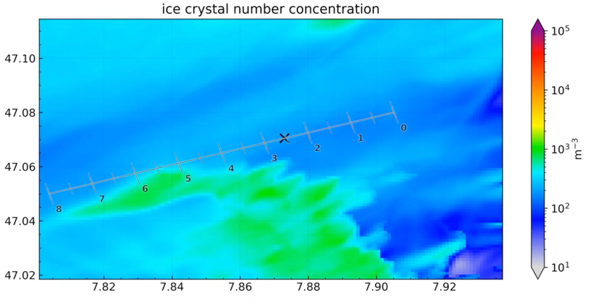
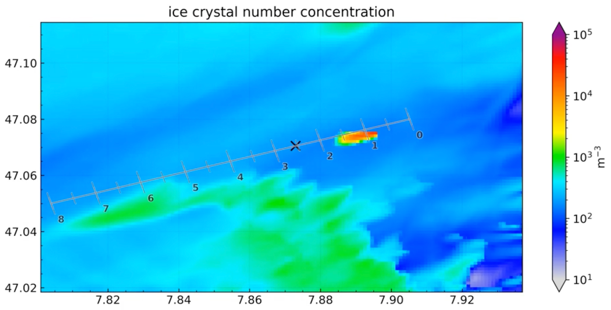
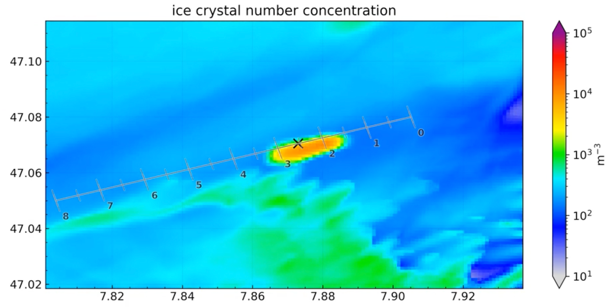
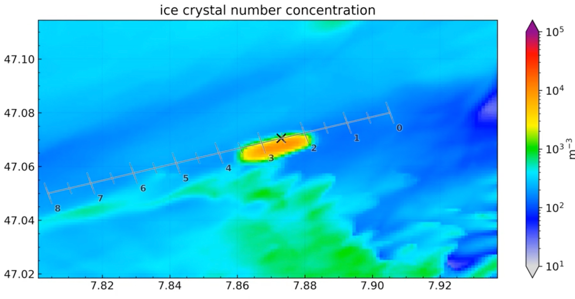
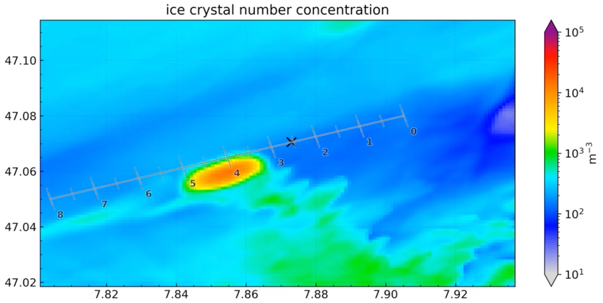
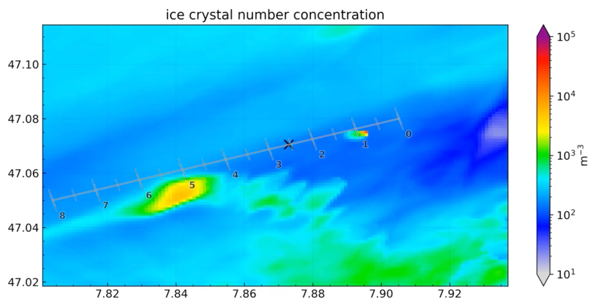
Figure 3 illustrates a time-height cross-section, of the 35-GHz radar reflectivity factor and linear depolarization ratio from 10:30 to 11:40 UTC on the corresponding day as the simulations. The occurrence of the plume event above the radar at 11:02 UTC closely aligns with the simulations. Next steps involve the evaluation of this event through a comprehensive model-observation comparison. This step aims to investigate deeper into the characteristics and dynamics of the observed phenomenon, enhancing our understanding through analysis and validation against simulated data.